| 
| Legal protections against HIV-related human rights violations: Experiences and lessons learned from national HIV laws in Asia and the Pacific (2013)
Increasingly, countries in the Asia-Pacific region have put in place HIV laws to provide legal protections for people living with HIV. In a follow-up to the report of the Global Commission on HIV and the Law, Legal Protections against HIV-related Human Rights Violations: Experiences and Lessons Learned from National HIV Laws in Asia and the Pacific systematically examines for the first time how these laws have been used and enforced to address rights violations. The report highlights gaps in laws and law enforcement practices. It identifies gaps that exist between ‘laws on the books’ and ‘laws on the streets’. In some countries good laws are in place, but people living with HIV still confront significant obstacles in gaining access to justice. Based upon the findings, the report provides a number of recommendations, including greater investments to enhance legal protections for people living with HIV and key populations, such as men who have sex with men, sex workers, transgender people and people who use drugs, through strengthened engagement of parliamentarians, judiciary, police, lawyers, national human rights bodies and other key institutions. In support of these actions, donors, including the Global Fund, should promote and allocate greater resources to support government and civil society programming on HIV-related human rights programming. Additionally, national HIV strategies and plans should include specific targeted actions for the legal sector, including law reform, provision of legal aid services and education of people living with HIV, lawyers and the judiciary on HIV-related rights issues. Download Publication
|
| 
| APRC Annual Report 2012 (2013)
The Annual Report 2012 highlights our work on achieving the MDG and advancing the post-2015 development agenda. It tells how we advocate gender equality and women’s political participation, and describes how we support countries in the region in addressing the challenges of climate change. Download Publication
|
| 
| Sex Work and the Law in Asia and the Pacific (2012)
The report is intended to provide an evidence-base for: policy makers working in government, regional and multilateral organizations; parliamentarians; members of the judiciary; civil society organizations; donor agencies; and sex workers and their organizations engaged in advocacy to improve the legal and policy enabling environment for HIV responses. The study focuses on 48 countries of the Asia-Pacific region, with an emphasis on low and middle-income countries. Download Publication
|
| 
| Gender Equality in Elected Office in Asia Pacific: Six Actions to Expand Women’s Empowerment (2012)
This publication provides an overview of women’s political representation in Asia-Pacific member states, and reviews the impact of series of six fast-track institutional reforms which can contribute towards the attainment of gender equality in elected office. These six “windows or opportunity” include an examination of legally binding quotas, constitutional rights, political party recruitment, capacity building initiatives, parliamentary reform and political party recruitment.
The six-step action plan is structured so national policy makers and practitioners working to increase women’s political involvement can select one window of opportunity to expanding women’s political participation most relevant to their specific context. Download Publication
|
| 
| Accelerating Achievement of MDGs by Ways and Means of Economic and Social Rights (2012)
This publication is the result of more than a year of discussions and exchanges on a variety of themes centered on what UNDP regards as its core mandate: the human development agenda. As the 2015 target date for the MDGs is rapidly approaching, and as efforts are underway to “accelerate” progress on various targets and indicators around the world, the debate about global development goals has already moved towards looking beyond 2015.
This collection of essays is aimed at offering insights into innovative and practical ways and means of realizing human rights, linked as they are to the MDGs primarily through social and economic rights, but also through the broader human rights context where the Millennium Declaration set development goals which later became known as the MDGs. The publication contributes to the debates among those thinking ahead of a future set of development goals and to also offer concrete guidance and inspiration to development practitioners in the field, in particular those working in areas related to the MDGs. The document is targeted at national government and non-governmental development experts equally as to those working in UN agencies, or other governmental or non-governmental organizations. Download Publication
|
| 
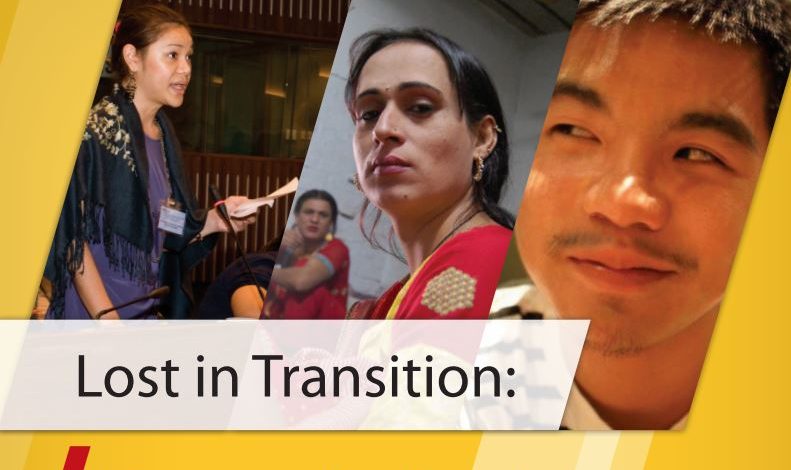
| Lost in Transition: Transgender People, Rights and HIV Vulnerability in the Asia-Pacific Region (2012)
This review examines existing literature on transgender people’s human rights and HIV vulnerability across the Asia-Pacific region. The focus in this report is mainly (though not exclusively) on lower income and middle income countries of the region. This is not to suggest that transgender people in more affluent countries do not experience challenges. On the contrary, they often find themselves excluded from economic opportunities enjoyed by others and end up facing many of the same challenges of survival as do trans* people in less developed economies. Download Publication
|
| 
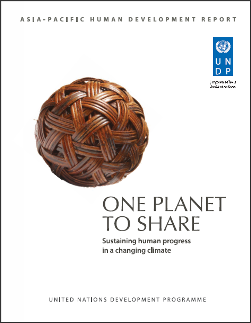
| Asia-Pacific Human Development Report: One Planet to Share - Sustaining Human Progress in a Changing Climate (2012)
The report analyses the climate change impacts from the perspectives of mountain dwellers, delta communities, islanders, indigenous and tribal peoples and the urban poor.
The report states that simultaneous action on both daptation and mitigation is required for building resilient societies in Asia and the Pacific. The report calls for alternative sustainable development paths that fulfill the urgent human development needs of today while preserving a habitable planet.
Download Publication
|
| 
| APRC Annual Report 2011 (2012)
The APRC Annual Report 2011 showcases our impact over the year highlighting results in priority areas of work including: MDG acceleration and social protection; gender equality; climate change and crisis resilience. Finding effective approaches to these complex issues required thinking outside of the thematic silos and combining the knowledge and expertise of all APRC practice teams. One of the most exciting results of these efforts is the cross-practice collaboration and the integrated interdisciplinary support that APRC is now able to offer to UNDP Country Offices across Asia-Pacific and its development partners. Download Publication
|
| 
| Accelerating Equitable Achievement of the MDGs: Closing Gap in Health and Nutrition Outcomes (2012)
This report underlines the extent of disparities across the region, looking especially at the wide gaps in the goals related to health and nutrition where the region is particularly under-performing. Even countires that have been making rapid economic progress still lose shocking numbers of children before their fifth birthday as well as thousands of mothers who did unnecessarily, as a consequence of the nautral process of childbirth. The report also reveals many opportunities for improving health outcomes - highlighting the policies and programmes which, when backed by commitment and adequate resources, could help make the Asia-Pacific region a driving forece behind the global achievement of all the MDGs.
The report has emerged from wide consultation, not just within and between the three partner organizations, but also many other UN agencies, particularly UNAIDS, UNICEF, UNFPA and WHO.
Download Publication
|
| 
| Towards an ‘Energy Plus’ Approach for the Poor: A review of good practices and lessons learned from Asia and the Pacific (2012)
This report documents good practices and lessons learned in addressing energy poverty and expanding energy services for the poor. It draws from the experiences of 17 energy access programmes and projects in the Asia-Pacific region. It highlights that breaking through the energy-poverty cycle is best achieved by combining the delivery of energy services with measures that generate cash incomes. This ‘Energy Plus’ approach has the greatest potential for reducing poverty and achieving the Millennium Development Goals.
Related Documents:
Download Publication
|
|
|
|
|
Loading
|
|
|
|